
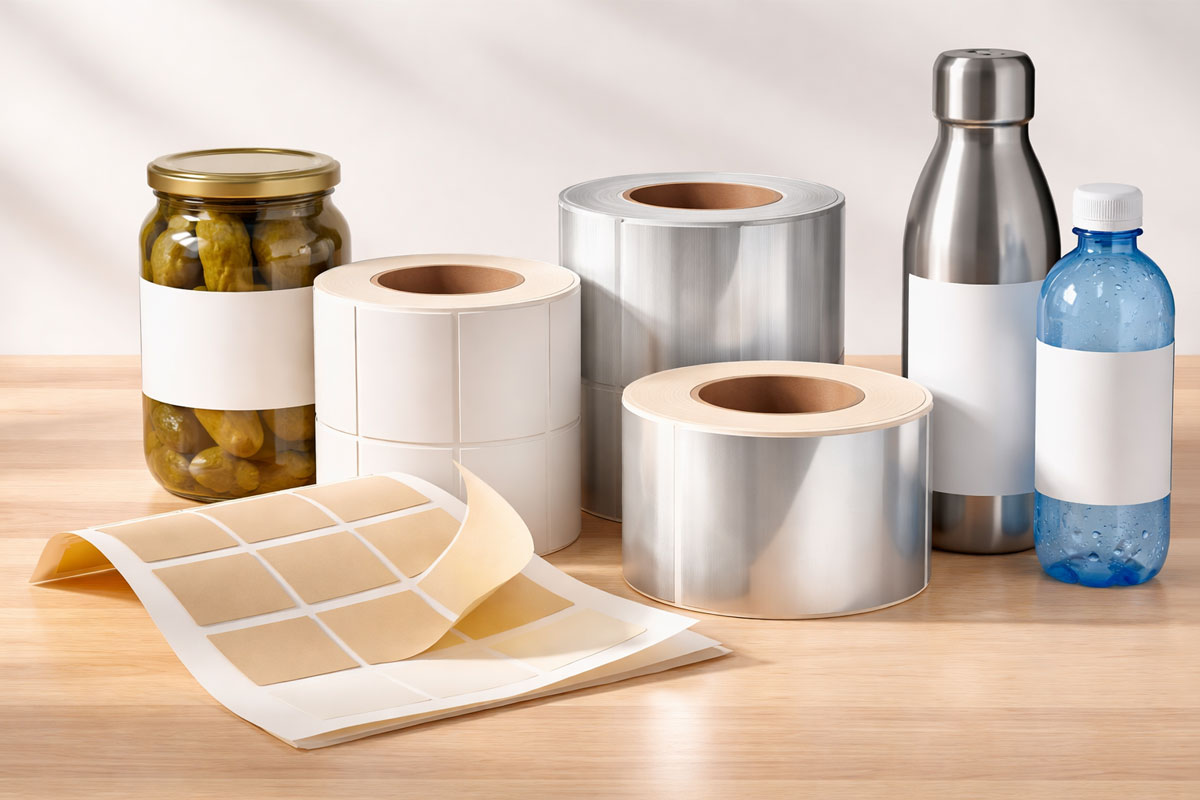
Learn how to choose the right label material for durable, compliant, and visually impactful product labels. Consider your product’s surface, expected lifespan, environmental exposure, and industry regulations. Partner with an experienced label supplier to ensure reliable performance and compliance across every application.
Label material refers to the combination of label stock (face material), adhesive, and protective coating used to ensure product labels remain readable, durable, and compliant in their intended environment.
Choosing the right label material is one of the most important decisions you’ll make when designing product labels, because it directly impacts your brand, adhesion, longevity, and regulatory compliance.
Your product labels do more than identify what’s inside the package, they communicate your brand identity. The images, colors, words, and logo work together to tell customers what your product represents and what your company stands for. If labels are difficult to read, wear easily, or fade, consumers may conclude you don’t hold the highest standards.
At the same time, label material plays a critical role in meeting regulatory requirements. Many industries mandate specific information remain legible for the life of the product. The right combination of label stock and adhesives ensures your labels stay secure, compliant, and professional from production through end use.
From refrigerated labels for food packaging to outdoor labels exposed to sunlight and moisture, each application requires a material designed for that specific use case.
6 Factors to Consider When Choosing a Label Material
1. Match Labels to Your Product or Packaging Material
The first step in selecting label material is identifying the surface where the label will be applied. Surfaces that are glass, plastic, metal, wood, or cloth require different label materials to ensure proper bonding. The shape of the product also matters. Curved or irregular containers require flexible labels that won’t tear or crack when you apply them or when the customer uses the product. If your product contains liquid, oil, or chemicals, or it will be exposed to water, cleaners, or grease, you’ll need moisture-resistant label stock that won’t degrade and adhesives that will stay in place. When selecting label stock and adhesives, always start with the product and packaging surface, then work backward to find the right combination of stock and adhesive.
2. Choose Labels Based on Use and Application Temperatures
Temperature significantly impacts label performance. Refrigerated labels and frozen product labels require adhesives formulated for cold environments. Standard adhesives may fail when exposed to refrigeration or freezer conditions, leading to edge lifting or detachment. Whereas, manufacturing labels are exposed to high heat and need a much different adhesive.
It’s also important to distinguish between:
- Application temperature (when the label is applied)
- Service temperature (the environment where the product is stored or used)
Both must be considered. A label applied in a warm facility but stored in a freezer must perform in both conditions.
Remember that temperature fluctuations can cause condensation, so you should consider whether labels need to be moisture-proof. Additionally, some products expand and contract as temperatures change. Flexible materials help ensure product labels remain secure and readable despite these shifts.
3. Ensure Labels Last for the Life of the Product
It makes sense to choose the most cost-effective product label, and this often depends on how long the label needs to last. A paper label can be a cost-effective choice if it only has to last until the consumer takes the product home and removes it. On the other hand, your product may need a heavy-duty, durable label that lasts and stays readable as long as the product is in use.
These labels help you comply with regulations like Underwriters Laboratory (UL) labeling for electrical devices or Unique Device Identifier (UDI) labeling for medical devices. Purpose-built labels for metal products are good choices for tagging tools or heavy equipment with information that helps to track them or provide service details. Although these durable labels are more expensive than paper labels, they pay off by delivering reliable performance throughout the product’s lifetime.
4. Evaluate Whether You Need Outdoor Labels
When product labels are used outdoors, temperature changes are a consideration. Labels exposed to snow and ice need to keep performing just like cold chain foods, and labels under direct sunlight can reach high temperatures, like in some industrial processes. However, when your products are routinely outdoors, you also need to consider other factors. UV light can cause fading, making labels impossible to read. Dirt and dust can cause abrasion that can also damage a label. When evaluating outdoor label material, consider every environment where your product may be stored, installed, or operated to avoid premature failure.
5. Select Labels that Meet All Compliance Requirements
In regulated industries, label material selection is not optional — it’s critical. Labeling required by law must last, stay in place and be readable, sometimes in the most extreme conditions. For example, GHS labeling, required by the Occupational Safety and Health Administration (OSHA) and the United Nations Economic Commission for Europe (UNECE), must include all statements, pictograms, hazard statements, and chemical categories and classifications. These labels must remain attached and legible even in extreme conditions, including seawater exposure. Similarly, FDA-regulated food labeling must remain readable through refrigeration, freezing, and room-temperature exposure cycles.
A thorough understanding of applicable labeling regulations, combined with carefully selected, performance-tested materials, is essential for maintaining compliance and protecting your business.
6. Support Customization and Branding with Your Labels
Beyond durability and compliance, it’s also important to make sure your labels have the right look and feel. Product labels are often a customer’s first impression, and appearance influences purchasing decisions. Choose label stocks that deliver sharp images, vibrant color, and crisp text. You may even want to consider adding a premium coating or finish, such as matte, gloss, metallic, or specialty coatings that can help your product stand out on crowded shelves. You may want to consider selecting adhesives that provide reliable performance while allowing clean removal without damaging the product’s surface when appropriate. If your goal is to make a strong statement about your commitment to quality or luxury, make sure the labels you choose enforce that message at every touchpoint.
The Perfect Label: Putting It All Together
Selecting the right label material isn’t just a technical decision, it impacts your product’s durability, compliance, and first impression with customers. From refrigerated labels to outdoor labels and metal product labels, every surface and environment requires a solution built for that specific use.
Partnering with an experienced provider ensures your product labels stay secure, legible, and professional throughout their lifecycle. The right combination of label stock, adhesive, and finish protects your investment, maintains regulatory compliance, and communicates your brand’s quality and reliability.
Gateway takes a consultative approach to selecting the proper labels for your products. First, we’ll thoroughly discuss your products, your brand, your processes, the environmental conditions the label will be exposed to. Next, we find the most cost-effective options that give you the best performance over your product’s lifetime. Request a free consultation today and get labels designed to last, protect, and impress.